The buy-and-sell sheet
Where to buy and sell Rust skins — and what each market keeps
Eight places sell Rust skins for real money and one of them is the game itself. This sheet prices the same item through every route — item store, Steam Community Market, and seven third-party marketplaces — with each fee read from the market's own pages on 9 September 2026. Bands, not tickers.
Cut list
The short answer
To buy Rust skins cheaply, check the weekly item store first ($1.49–$3.49 per skin at the 3 September 2026 rotation) and then a cash marketplace — Skinport or DMarket — for anything that has left the store. To sell Rust skins for money you cannot use Steam at all: the Community Market pays in wallet funds and keeps 15%; the third-party markets below pay PayPal, bank or crypto and keep 2–10% on a published fee, or an unpublished spread on a quote.
That is the whole sheet in two sentences. The rest is the receipts: what each market said it charges on the day we read it, what a $100 Rust skin actually nets through each door, and the store and workshop mechanics that decide why a $1.99 skin from 2017 lists for over $300 today.
| Market | Rust support | Seller fee | Buyer fee | Payout | Best for | Grade |
|---|---|---|---|---|---|---|
| Skinport | Yes — dedicated Rust storefront | 8% (6% above ~€1,000; 2% private) | 0% | Bank / PayPal | Selling at a published rate | 8.6 |
| DMarket | Yes — 45,788 Rust offers on read date | ~2% standard, up to ~10% low-liquidity; F2F ~4% | 0% | PayPal, SEPA, card, crypto (withdrawal 1–3%) | Buying deep inventory cheaply | 8.2 |
| SkinSwap | Yes — Rust sell, buy and trade pages | Quote-based (fee inside the offer) | 0% on listed price; 40% deposit bonus on buys | PayPal, BTC, ETH, LTC | Instant cash on mid-value items | 7.4 |
| Swap.gg | Yes — Rust trade bot + instant sell | Spread, not published | — | Site balance / instant sell | Swapping skins without cash | 6.9 |
| Tradeit | Yes — Rust store, sell and trade | 0–30% per its own page; −3% with tradeit.gg in Steam name | — | Crypto, bank, debit card; cash-out 2% ($10 min) | Trading up between games | 6.8 |
| Lis-Skins | Yes — Rust market + instant sell | 6–10% trading; instant-sell ≈90% of value (conflicting reports) | 0% | Card 3.5% + €0.50; crypto 0.4% + network | EU card payouts on small lots | 6.5 |
| SkinBaron | Listed — depth not verified on read date | Not published; payment fees 5–15% by method | 0% | EUR bank, monthly | EU sellers already on the platform | 6.0 |
| Steam Community Market | First party | 15% (5% Steam + 10% game) | 0% | Steam Wallet only | Buying more skins, never cashing out | 5.5 |
Grades are computed from three things and nothing else: whether the fee is published, what a $100 sale nets after payout costs, and whether the market has verifiable Rust depth. Affiliate commissions do not enter the grade; several of the markets we grade lowest pay the most.
How a Rust skin reaches the market
Every tradable Rust skin starts as a Steam Workshop submission that Facepunch sold in the item store for a week, and most never come back. That single fact explains the whole price structure, so it is worth the paragraph before any fee.
The item store rotates weekly on Thursdays. The 3 September 2026 rotation carried 12 items priced $1.49–$3.49, and Facepunch's own workshop FAQ says skins "are removed when they've been around for a long time or have made too much money." Anything you buy from the store is locked — it cannot be traded or listed on the Steam market for a minimum of seven days — after which most items become tradable and marketable. Exceptions matter: event and Twitch-drop skins (Charitable Rust, Trust in Rust, drops rounds) never become tradable, and items in Facepunch's permanent store "hold no resale monetary value" per the November 2021 announcement.
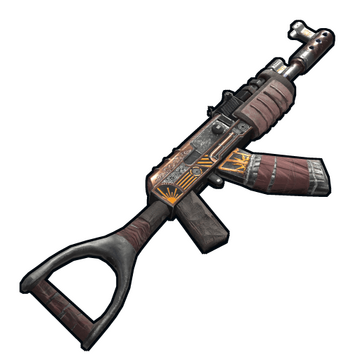
Once an item is out of the store, supply is fixed. Demand is not. That is how a Glory AK47 bought for $1.99 in April 2017 sat at a $345.00 lowest listing on 9 September 2026, and how a Tempered AK47 — which competitor lists still price at "$200–$500+" — showed a $11.61 lowest listing with 79 sellers the same day. The item store explainer walks the mechanics; this page is about the doors.
Steam Community Market: the 15% baseline
Steam is where every Rust price is anchored and where nobody should sell. Valve keeps 15% of every Rust sale — a 5% Steam transaction fee plus a 10% game-specific fee — and pays the remaining 85% into your Steam Wallet, which cannot be withdrawn. Sell a $100 skin and you hold $85 that can only buy more Steam things.
For buying, the Community Market is fine and sometimes cheapest for liquid $1–$3 items where third-party markets' payout minimums make listing pointless. For anything worth real money the 15% cut is priced in: sellers who want $100 in hand list at ~$117.65, so the buyer pays the tax either way. Third-party markets exist because 2–8% beats 15% for both sides.
One thing Steam did not do to Rust: the July 2025 Trade Protection that made CS2 trades reversible for seven days applies to CS2 items only. Rust items follow the older rules and cannot even be included in a trade offer alongside protected CS2 items. Any Rust guide talking about "reversible trades" is copying CS2 news.
Skinport — the published-rate seller
Skinport is the cleanest place to sell Rust skins for cash because the fee is a number on a page: 8% of the sale price, 6% for high-value items above a currency-dependent threshold (about €1,000), 2% for private listings, and 0% for buyers. Skinport cut the standard rate from 12% to 8% in September 2025, and it runs a dedicated Rust storefront.
A $100 Rust skin nets $92.00 before payout to bank or PayPal. The trade-off is patience: Skinport is a listing market, so you wait for a buyer at your price rather than taking an instant quote. For anything above $20 that wait is usually worth several dollars against instant-sell offers.
Two caveats. Skinport's affiliate programme is application-only, so our link is the plain storefront until that changes — it does not affect the grade. And listing items straight from a store purchase is impossible for seven days; plan the lock in.
Affiliate link: we may earn a commission if you trade there. It never changes a fee figure on this sheet.
DMarket — deepest Rust inventory, lowest headline fee
DMarket had the most Rust supply we could count on the read date: 45,788 Rust offers across Armor (4,618), Clothing (11,614), Misc (14,652), Resource (288) and Weapon (14,616) categories on 9 September 2026. For buyers that depth means price discovery works — there are usually several sellers per common door or box skin.
The seller fee is roughly 2% on standard items, rising to about 10% on low-liquidity items, with Face2Face trades around 4% and item-for-item exchanges around 2.5%. Withdrawals to PayPal, SEPA, card or crypto carry their own 1–3%, so a $100 sale lands at about $95–$97 in the bank on a liquid item and $87–$89 on an illiquid one. DMarket's own fee page returned a 403 to our re-read, so those figures are the 4 September 2026 verification from our partner sheet, not a fresh read — treat them as bands.
Affiliate link: we may earn a commission if you trade there. It never changes a fee figure on this sheet.
SkinSwap — instant cash, fee inside the quote
SkinSwap is an instant-sell and trade site that pays PayPal, Bitcoin, Ethereum and Litecoin, and it explicitly handles "both Rust and CS2 skins." It does not publish a seller percentage. Its Rust sell page says there are "no hidden fees" on payout methods, which is true and also not the point: the fee is the gap between the quote you accept and the Steam price.
Read that gap before clicking. The same site advertises a 40% deposit bonus for buyers, and bonuses that large are funded by prices that carry the same margin. SkinSwap is best when you want money today for mid-value items and can compare its quote against a Skinport listing minus 8%.
Affiliate link: we may earn a commission if you trade there. It never changes a fee figure on this sheet.
Tradeit — trading between games, opaque fees
Tradeit runs a Rust store, a Rust sell page and a Rust trade bot, and its sell page states the fee honestly: "usually range from 0% to 30% of the item's sale value, depending on the skin and current promotions." Putting "tradeit.gg" in your Steam name takes 3% off. Cash-out goes to crypto, bank transfer or debit card at 2% with a $10 minimum, and leaving funds as balance earns "up to 40% bonus" — which tells you where the margin lives.
For a $100 skin at a mid-range 10% fee you net $90, minus 2% cash-out: $88.20. Tradeit's real use case is moving value between Rust, CS2 and TF2 inventories in one trade rather than converting to cash.
Affiliate link: we may earn a commission if you trade there. It never changes a fee figure on this sheet.
Swap.gg — the trade bot
Swap.gg is a trade-bot site with a Rust trade page and a Rust instant-sell option. It prices items by "market data analysis" and does not publish a percentage; the fee is the spread between what your item is valued at and what the bot's items cost. It is a reasonable way to turn six $2 skins into one $12 skin without touching cash, and a poor way to cash out — for that, use a listing market.
Affiliate link: we may earn a commission if you trade there. It never changes a fee figure on this sheet.
Lis-Skins — card payouts, conflicting rates
Lis-Skins runs a Rust market and an instant-sell that pays to card or crypto. Our partner sheet, verified 4 September 2026, records a 6–10% trading fee, instant-sell at about 90% of value, and payout costs of 3.5% + €0.50 by card or 0.4% plus network fees in crypto. A 2026 third-party review claims instant-sell pays closer to 60% of Steam value. The two cannot both be right, the site returned a 403 to our own re-read, and so we print the conflict rather than pick a number. Treat any Lis-Skins quote as one to compare, not to accept.
Affiliate link: we may earn a commission if you trade there. It never changes a fee figure on this sheet.
SkinBaron — EU seller, Rust depth unverified
SkinBaron is a German cash marketplace whose site assets carry a Rust game icon and whose programme listing names Rust among supported games, but the storefront we loaded on 9 September 2026 was CS2-branded and we could not verify Rust listing depth. Payment-method fees are published (SOFORT 5%, Paysafe withdrawal 15%, card 5% + €0.35); the seller fee is not. EU sellers already on the platform may find it convenient; nobody should join it for Rust without checking that the Rust category actually has buyers.
Affiliate link: we may earn a commission if you trade there. It never changes a fee figure on this sheet.
What a $100 Rust skin nets through each door
The fee table becomes concrete when one item goes through every route. Assume a Rust skin that clears at $100 on Steam and can be sold at parity elsewhere; payout fees included where published.
- Steam Community Market: $85.00 — in wallet funds you cannot withdraw.
- Skinport: $92.00 before bank/PayPal payout; $94.00 above the high-value threshold.
- DMarket: about $98.00 on a liquid item, minus 1–3% withdrawal — roughly $95–$97; about $87–$89 on an illiquid one.
- Tradeit at a mid-range 10%: $90.00, minus 2% cash-out — $88.20; $10 minimum.
- Lis-Skins at 6–10%: $90–$94, minus 3.5% + €0.50 by card — roughly $86–$90.
- SkinSwap / Swap.gg: whatever the quote says; check it against $92 from Skinport before accepting.
At $2.60 — the Hazma Egg Garage Door's lowest Steam listing on 9 September 2026 — none of this matters. Percentages on cents lose to payout minimums; sell $2 skins on Steam and spend the wallet, or bundle a dozen into a trade bot.
One item, every market, one day
Fee tables are abstract; a single item priced everywhere on the same day is not. The SCMM tracker's cross-market read on 9 September 2026, taken the same day as our Steam figures, for four items that have left the store:
- Glory AK47 — Steam $345.88 (7 listings); DMarket $235.90 (11); lowest cash ask $226.35.
- Big Grin — Steam $1,325.92 (8); Skinport $937.02 (18); DMarket $921.99 (7).
- Spacesuit — Steam $15.00 (48); Skinport $12.01 (21); DMarket $10.69 (71).
- Whiteout Hoodie — Steam $22.00 (254); DMarket $15.26 (116); Lis-Skins $15.43 (323).
The cash markets sit 25–35% under Steam on every one. Roughly 15 points of that is Valve's cut, priced into every Steam ask; the rest is that cash buyers are scarcer than wallet buyers, so cash asks have to be lower to clear. For a buyer with a card that gap is the discount; for a seller it is why the Steam price is not the price you get anywhere.
Where to buy Rust skins cheapest
The cheapest source of a skin is the item store during its week, full stop. A skin in rotation costs $1.49–$3.49 with no fee, no lock on your wallet, and no seller markup; the same skin on a third-party market a month later carries whatever the market decided. If a skin you want is in the current rotation, buy it there and accept the seven-day lock.
After that: DMarket for depth and lowest fee, Skinport for a clean listed price, Steam for $1–$3 commodity items where a third-party payout minimum would exceed the profit. Trade bots (Swap.gg, Tradeit, SkinSwap) are for swapping, not bargain hunting — a "40% bonus" is a markup with a bow on it. And never a case site: Rust "case opening" sites are gambling, not a place to buy skins, and any "free Rust skins for a deposit" page is one of them.
Console players: nothing here applies
Rust Console Edition is a separate game with a separate inventory. Console skins are bought in its own store, are locked to the Xbox or PlayStation account, and are neither tradable nor marketable — there is no Steam Market on console and no third-party market either. Every market on this sheet is for the PC (Steam) game only.
How we read this sheet
Every fee above is the marketplace's own published rate, read on 9 September 2026 where the page would load; where it would not (DMarket's fee article and Lis-Skins returned 403s to our request) we say so and cite our 4 September 2026 partner verification. Prices are Steam Community Market lowest listings on the read date, printed as bands. BitSkins closed on 30 June 2026 and is not on this sheet, and we never link to scams. Some links are affiliate links and are disclosed next to each; the affiliate disclosure explains how that money works and why it cannot move a grade.
Related sheets: sell Rust skins for real money (the selling walkthrough), the item store explained, Rust trade sites compared, and the best Rust skins by item.